

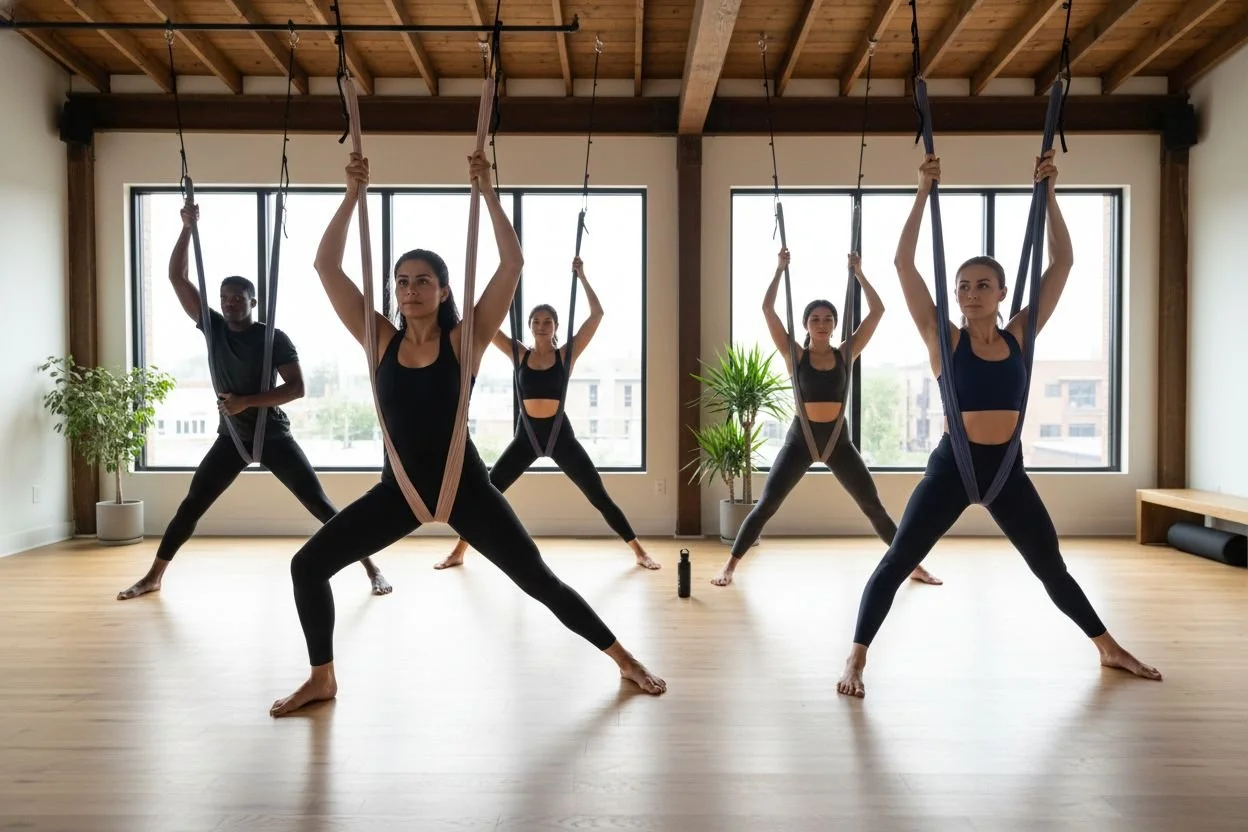
The capacity of an aerial studio cannot be calculated by dividing its floor area by the size of a yoga mat. Each hammock needs a certified overhead support point, adequate clearance and enough surrounding space for controlled movement. When booking aerial yoga, participants are therefore entering a class whose safe capacity depends on physical and instructional constraints.
Adding another hammock is not equivalent to placing another mat on the floor. It affects rigging loads, participant spacing, instructor visibility and access during transitions.
Rigging Determines the Maximum Physical Capacity
Every hammock must connect to an overhead structure designed to support the loads created during use. The relevant load is not limited to the participant’s stationary body weight. Entry, swinging and sudden movement can generate greater forces.
Rigging design should be managed by appropriately qualified professionals and used according to equipment specifications. Studios should maintain inspection and replacement procedures for fabric, attachment hardware and supporting systems.
A visually convenient ceiling point is not automatically a suitable anchor. The number and location of approved rigging points establish the upper limit before business considerations are applied.
Participants should never attach, move or adjust structural hardware themselves.
Floor Area Still Matters
Even when the ceiling contains multiple anchor points, hammocks require lateral clearance. Participants may extend their arms and legs, rotate or move the fabric away from its resting position.
If hammocks are placed too closely, one participant’s movement can enter another person’s working area. This creates distraction and may increase collision risk.
The required spacing depends on the class content. A session involving mostly supported standing movements may use space differently from one involving broad suspended shapes. Studios should set capacity according to the most space-intensive planned movement, not only the position of participants at the start of class.
Sightlines Are a Coaching Resource
An instructor needs to see whether fabric is positioned correctly and whether participants are following the entry sequence. Poor sightlines can hide important details such as a twisted hammock, an insecure grip or an incorrect leg placement.
Columns, mirrors, hanging fabric and participants themselves can obstruct the view. A class may technically fit inside the room while still being difficult to supervise.
Good layout allows the instructor to scan the class without remaining in one fixed position. Mirrors can help, but they should not replace a direct view. Reflections may reverse orientation or conceal depth.
Instructor Access Must Remain Open
The instructor may need to approach a participant during a transition. Narrow paths between hammocks slow that response and can force the instructor to move through another participant’s space.
Access becomes especially important when several participants need help simultaneously. This can occur during the first attempt at an unfamiliar movement or when a transition contains multiple steps.
A suitable layout preserves clear routes through the room. Bags, water bottles and personal belongings should be stored away from these paths.
Capacity should therefore be assessed according to usable teaching space, not total room size.
Participant Experience Changes the Workload
A class of experienced participants may require a different level of supervision from a session containing several first-time attendees. New participants often need more explanation about fabric placement, grip and controlled entry.
This does not mean beginners should be excluded from group classes. It means the studio should account for instructional demand when scheduling and setting limits.
Useful operational approaches include:
- Requiring first-time participants to arrive early.
- Offering an introductory briefing.
- Limiting newcomers in selected sessions.
- Using clear prerequisite descriptions.
- Providing simpler alternatives within the class.
- Assigning additional instructional support when appropriate.
A studio should avoid relying on experienced participants to coach newcomers. Informal help can create inconsistent instructions and distract both people.
Capacity Affects the Pace of the Class
Large classes generally require more time for demonstrations, equipment checks and transitions. If the timetable does not allow for this, the instructor may feel pressured to move quickly.
Rushed transitions are particularly unsuitable in aerial practice. Participants need enough time to identify the correct fabric position and understand how to exit before adding suspension.
A realistic class plan includes setup, instruction, practice, rest and equipment reset. The exercise list should fit the available time without treating safety checks as delays.
The Business Trade-Off
Aerial classes involve fixed costs, including specialised equipment, inspection, instructor training, rent and administrative systems. A smaller class may provide more individual attention, but it must still generate enough revenue to remain viable.
Increasing capacity can improve revenue per session, but only until the experience deteriorates. Overcrowding may reduce retention, increase instructor stress and create negative feedback.
Studios can improve economics through better scheduling rather than simply adding hammocks. Options include:
- Analysing peak and off-peak demand.
- Operating reliable waitlists.
- Reducing preventable no-shows.
- Adding sessions around consistently full time slots.
- Matching class formats to participant experience.
- Tracking retention rather than only attendance.
In Singapore, after-work and weekend demand may concentrate bookings into a narrow set of periods. Understanding commuting patterns can help a studio design useful start times.
What Participants Can Observe
Clients do not need technical rigging knowledge to evaluate the class environment. They can notice whether the space feels controlled and whether the instructor can monitor the room.
Positive signs include clear equipment checks, adequate personal space and unblocked access routes. The instructor should explain how to request assistance and should be able to offer modifications without losing control of the rest of the class.
A session that feels exclusive because it is crowded is not necessarily providing better value. Practical coaching access matters more than atmosphere alone.
Capacity Is Part of the Safety Design
At Yoga Edition, participants can support efficient class operations by arriving on time, following setup instructions and keeping personal items away from the practice area. Disclosing relevant limitations before class also allows the instructor to plan modifications.
For the studio, capacity should reflect the weakest constraint in the system. That may be the number of approved rigging points, the available clearance, the instructor’s sightlines or the ability to reach participants quickly.
Aerial yoga capacity is therefore a design decision, not merely a sales target. When rigging, spacing and coaching access are considered together, the class can remain commercially sustainable without treating participant safety or instructional quality as negotiable.